
Softwares used in optometry refer to specialized digital solutions that support the management of eye care clinics, streamline patient records, and integrate diagnostic imaging tools. These platforms help optometrists improve workflow efficiency, ensure accurate visual health tracking, and maintain compliance with healthcare standards. They differ by providing an integrated framework that manages both clinical data and retail transactions in a centralized digital environment.
Key Takeaways
- Optometry software enhances patient care, data accuracy, and clinic efficiency.
- EHR and PMS systems form the backbone of modern optometric practices.
- Diagnostic imaging and POS tools enable seamless clinical-retail integration.
- Cloud-based and AI-enabled platforms define the future of optometric technology.
What Kinds of Software Solutions Support Optometry Clinics?
The main types of softwares used in optometry include tools for clinical, administrative, and optical retail functions.
Key categories include:
- Electronic Health Records (EHR): Store and manage patient histories (e.g., RevolutionEHR).
- Practice Management Systems (PMS): Handle appointments, billing, and insurance claims.
- Optical POS Software: Oversees frame and lens stock while streamlining point-of-sale operations.
- Diagnostic Imaging Software: Integrates with retinal cameras and OCT scanners for precise analysis.
- Teleoptometry Software: Supports remote consultations and virtual exams.
How Do EHR Systems Improve Efficiency in Optometry Practices?
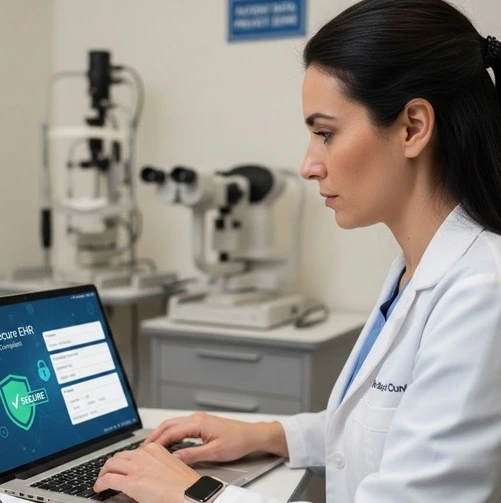
EHR systems centralize all patient-related data into one secure digital platform.
Advantages:
- Streamlined patient history retrieval.
- Reduced manual errors in prescriptions.
- Integration with diagnostic devices for image storage.
- Automated reminders for follow-up appointments.
Industry standards such as HIPAA compliance and HL7 interoperability ensure data privacy and system compatibility.
Which Optometry Practice Management Software Offers the Best Functionality?
The following are widely recognized optometry management platforms:
| Software Name | Core Function | Notable Features |
| RevolutionEHR | All-in-one EHR + PMS | Cloud-based access, billing automation |
| Crystal Practice Management | Scheduling + Billing | Custom templates, insurance claim tools |
| Compulink Advantage | Workflow management | Built-in analytics, optical POS integration |
| Adit | Practice marketing + management | Online booking, telehealth, and reminders |
These tools are widely used by clinics in both the U.S. and Canada for streamlined workflows and scalable operations.
What Role Does Diagnostic and Imaging Software Play in Optometry?
Diagnostic imaging software is crucial for accurate visual assessments and long-term monitoring.
Examples include:
- Altris AI: Automates OCT image analysis and disease detection.
- Topcon IMAGEnet: Integrates with imaging hardware for detailed visualization.
These systems promote standardized diagnostic outcomes and assist in identifying ocular conditions such as glaucoma or macular degeneration at an early stage.
How Does Optical POS Software Enhance Retail Efficiency in Optometry Clinics?
Optical POS software supports retail operations linked to eyewear and lens sales.
Core functions:
- Inventory tracking
- Price management
- Real-time stock updates
- Integration with PMS and accounting tools
Systems like MyVisionExpress POS enable end-to-end visibility from frame selection to customer payment.
A related concept often discussed with optical POS is eyecare software, which extends functionality to include frame fitting and prescription lens customization.
What Technology Integrations Define Modern Optometry Software Systems?
Modern softwares used in optometry are increasingly integrated with advanced technologies:
- Utilizing cloud storage provides both robust data safety and convenient remote connectivity.
- Telehealth modules for virtual consultations.
- AI-based diagnostics for automated image interpretation.
- Mobile compatibility for real-time patient engagement.
Interoperable systems help synchronize clinical, diagnostic, and retail components under a unified dashboard.
How Are Free Optometry EHR Solutions Supporting Independent Clinics?
Free or low-cost optometry EHR platforms, such as iPlum and OpenEMR, support smaller clinics with essential functionality:
- Secure patient record management.
- Appointment and billing integration.
- Basic analytics and reporting.
These tools make digital transformation accessible without compromising clinical reliability.
Conclusion
Softwares used in optometry are central to delivering efficient, accurate, and patient-focused eye care. From EHR systems to diagnostic imaging tools, these solutions integrate clinical and commercial processes for optimized performance. To explore deeper insights into implementation and interoperability, refer to related discussions on optometry softwares for a broader understanding of digital transformation in vision care.
FAQ
What software do optometrists use?
Optometrists use EHR, practice management, optical POS, and diagnostic imaging software to manage clinical and retail operations.
What technology is used in optometry?
Technologies include OCT imaging, teleoptometry, AI-assisted diagnostics, and integrated cloud-based systems.
Which is the best software for optical shop?
The best options include RevolutionEHR, Crystal Practice Management, and MyVisionExpress POS for combined clinical and retail features.
What is the tool optometrists use?
Optometrists use autorefractors, OCT scanners, and integrated diagnostic software to analyze eye health and vision accuracy.
Sources
- Capterra – Optometry Software Directory
- EHNOTE – Optometry Practice Software
- Altris AI – Optometry Practice Management Software Overview
- eClinicalWorks – Vision EHR Solutions
- Appvizer – Optometry Software Comparison
- Adit – Optometry Practice Management Software Launch
- iPlum – Best Optometry EHR Software Review
- RevolutionEHR – Best Optometry EMR Software Blog